
Table of Contents
ToggleIntroduction
The E-Commerce industry is evolving rapidly, and Shopify has become one of the most powerful platforms for launching and scaling online stores. However, simply creating a Shopify store does not guarantee sales. Thousands of businesses compete for attention online, which means brands must actively promote their products and build relationships with potential customers. This is where Social Media Marketing for Shopify Stores becomes one of the most important growth strategies in 2026.
Today’s customers spend a large portion of their time on social media platforms. Before purchasing a product, many users first discover it on Instagram, TikTok, or Facebook. They watch short videos, read reviews, and follow influencers who recommend products. This behavior has transformed social media into a powerful sales channel for eCommerce businesses. When implemented correctly, Social Media Marketing for Shopify Stores helps brands increase visibility, drive targeted traffic, and generate consistent revenue.
At Khushi samanta digital, widely recognized as the best digital marketing agency in Ahmedabad, we have helped multiple Shopify businesses grow through strategic social media campaigns, paid advertising, and content marketing. Our experience working with eCommerce brands has shown that a structured Shopify social media marketing strategy always performs better than random posting or inconsistent advertising.
This Social Media Marketing Guide for Shopify Stores in 2026 explains the exact step-by-step framework that Shopify brands can use to build authority, attract customers, and scale their businesses. The strategies shared in this guide follow Google EEAT guidelines and are designed to perform well in search engines, AI search tools, and modern discovery platforms.
If you are still researching profitable products for your store, we recommend reading Best Product Discovery Strategies for E-Commerce Stores (Step-by-Step Guide) in 2026, where we explain how successful brands identify trending products before launching marketing campaigns.
Social Media Marketing Guide for Shopify Stores in 2026 (Step-by-Step)
1. Define Your Target Audience
Before starting Social Media Marketing for Shopify Stores, it is essential to understand who your ideal customers are. A clear understanding of your audience helps businesses create content that resonates with potential buyers and improves the effectiveness of advertising campaigns. Without proper audience research, even the best marketing campaigns may fail to generate results.
Every successful Shopify social media marketing strategy begins with detailed audience analysis. Businesses should identify the demographics, interests, and behaviors of their potential customers. Understanding the age group, gender, lifestyle preferences, and purchasing habits of your audience allows you to create targeted content that solves their problems and answers their questions.
For example, fashion and lifestyle products often perform extremely well on Instagram because the platform focuses on visual storytelling. Choosing the best social media platforms for Shopify stores helps brands maximize engagement and conversions. On the other hand, trending gadgets or innovative products often gain popularity quickly on TikTok due to its viral content format. Recognizing these behavioral patterns helps Shopify brands select the right platform for Social Media Marketing for Shopify Stores.
At Khushi samanta digital, we start every campaign with comprehensive audience research. This includes analyzing customer interests, reviewing competitor strategies, and identifying high-value customer segments. By doing this, we ensure that Shopify businesses reach the right audience and maximize the impact of their marketing efforts.
2. Optimize Your Shopify Store Before Marketing
Driving traffic to an unoptimized website rarely produces good results. Many Shopify store owners focus heavily on marketing but overlook the importance of optimizing their website experience. Before launching campaigns for Social Media Marketing for Shopify Stores, businesses must ensure that their Shopify store is fully optimized for conversions.
A well-optimized Shopify store should load quickly, provide a seamless mobile experience, and present products in a visually appealing way. High-quality product images and clear descriptions help customers understand the benefits of the product. Additionally, a simple checkout process reduces friction and increases the likelihood of completing purchases.
Trust signals also play a major role in converting visitors into customers. Customer reviews, secure payment icons, and transparent return policies create confidence and encourage users to buy. When visitors trust a website, they are more likely to complete transactions.
At Khushi samanta digital, we often optimize Shopify websites before launching advertising campaigns. Our experience shows that improving website performance significantly increases the effectiveness of Social Media Marketing for Shopify Stores because visitors arriving from social media are more likely to convert.
Businesses interested in scaling their online store can explore our e-commerce marketing services to build a strong foundation for long-term growth.
3. Choose the Best Social Media Platforms
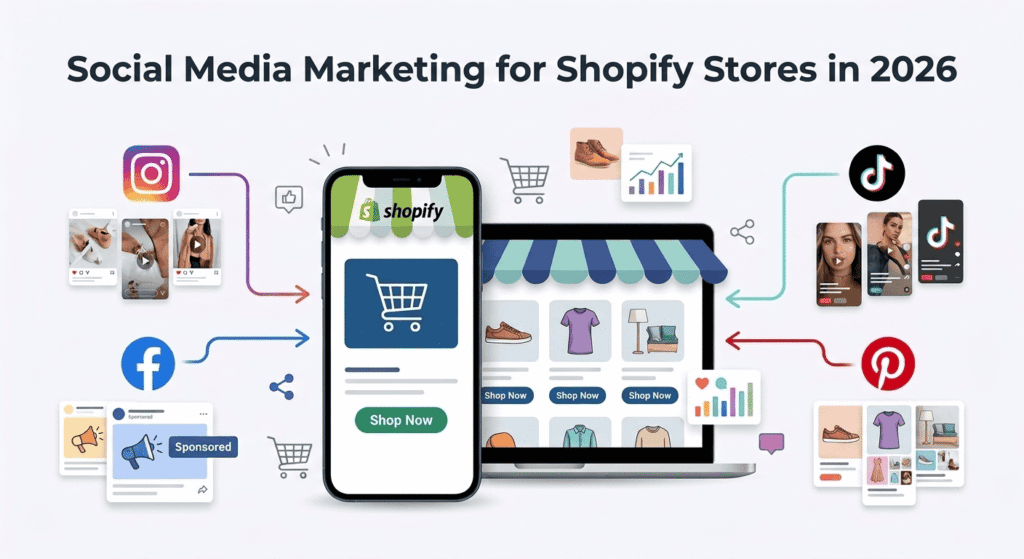
Selecting the best social media platforms for Shopify stores is one of the most important decisions in Social Media Marketing for Shopify Stores. Not every platform delivers the same results, and different product categories perform better on specific networks.
Instagram is one of the most effective platforms for Shopify businesses that rely on visual presentation. Fashion brands, beauty products, and lifestyle accessories often achieve strong engagement on Instagram because customers enjoy browsing visually appealing content.
Facebook also plays a significant role in paid advertising. Many Shopify brands rely on Facebook ads for Shopify stores to reach targeted audiences and drive conversions. These ads allow businesses to target users based on interests, demographics, and behavior.
TikTok has emerged as one of the fastest-growing platforms for product discovery. Viral content on TikTok can introduce products to thousands of users in a short period of time, making it a powerful channel for Social Media Marketing for Shopify Stores.
Pinterest is another valuable platform, especially for niches such as home decor, DIY, fashion, and event planning. Many users treat Pinterest like a search engine where they look for inspiration and product ideas.
At Khushi samanta digital, we help Shopify businesses choose the most effective platform combination based on their audience behavior and industry trends.

4. Create a Monthly Content Strategy
Consistency is one of the most important elements of successful Social Media Marketing for Shopify Stores. Many Shopify businesses struggle because they post content randomly without a clear plan. A structured Shopify social media marketing strategy ensures that brands maintain a regular presence on social media platforms.
A monthly content calendar helps businesses organize their ideas and maintain consistency. Instead of posting occasionally, Shopify brands can plan their content in advance and focus on delivering valuable and engaging posts.
Content should not always focus on selling products. Educational posts, product demonstrations, customer testimonials, and behind-the-scenes stories create a stronger emotional connection with the audience. When customers feel connected to a brand, they are more likely to purchase from it.
At Khushi samanta digital, we typically recommend posting at least four to five times per week to maintain visibility. Combining educational and promotional content helps businesses build trust while still promoting their products effectively.
For brands looking to improve their content strategy, the article 10 Amazing Tools For Generating Blog Post Ideas provides valuable insights into creating engaging content topics.
5. Use Organic Social Media Growth
Organic engagement plays a critical role in organic social media marketing for Shopify because it builds brand credibility and trust. When customers regularly see valuable content from a brand, they become familiar with the products and are more likely to purchase.
Organic growth strategies include creating short videos, responding to comments, using relevant hashtags, and encouraging customers to share their experiences. User-generated content is particularly powerful because it demonstrates real people using and enjoying a product.
Brands that focus on organic social media marketing for Shopify often develop stronger relationships with their audiences. This relationship increases customer loyalty and encourages repeat purchases.
At Khushi samanta digital, we help Shopify brands design organic social media marketing for Shopify strategies that complement paid advertising campaigns and strengthen overall brand authority.
6. Launch Paid Social Ads for Shopify
While organic growth is important, paid social ads help businesses scale much faster. Many brands rely on Facebook ads for Shopify stores to reach targeted audiences who are most likely to purchase their products.
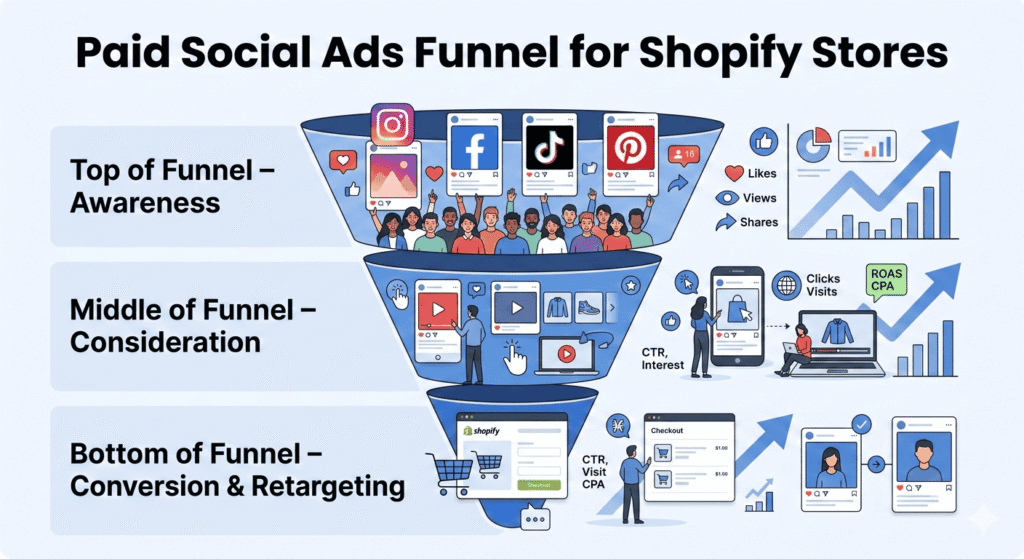
A successful advertising strategy usually follows a marketing funnel. The first stage focuses on introducing the product to potential customers. The second stage provides more detailed information about the product’s benefits. The final stage encourages users to complete their purchase.
Retargeting campaigns are particularly effective in Social Media Marketing for Shopify Stores. These campaigns display advertisements to users who have previously visited a Shopify store but did not complete a purchase. Since these users already showed interest in the product, retargeting ads often produce higher conversion rates.
7. Collaborate With Influencers
Influencer partnerships have become a major component of Social Media Marketing for Shopify Stores. Influencers already have established audiences that trust their recommendations.
Micro-influencers often deliver better engagement than larger influencers because their audiences are more niche and loyal. Shopify brands can collaborate with influencers through product reviews, sponsored posts, or affiliate partnerships.

8. Track Analytics and Performance
Tracking performance metrics is essential for improving Social Media Marketing for Shopify Stores. Businesses must analyze campaign data to understand which strategies are generating results and which ones require improvement.
Important metrics include engagement rate, website traffic from social media, conversion rate, and return on ad spend.
9. Optimize Content Based on Data
Once businesses gather performance data, they can refine their Shopify social media marketing strategy to improve results. Optimization involves analyzing which content formats generate the most engagement and focusing more resources on those formats.
For example, if short-form videos generate the highest engagement, Shopify brands should increase their video content production. Similarly, if influencer collaborations produce strong results, businesses can expand their influencer marketing efforts.
At Khushi samanta digital, we continuously test and optimize campaigns to ensure that social media marketing for Shopify stores remains effective and adaptable to changing trends.
10. Scale Your Shopify Store Marketing
Once marketing campaigns start producing consistent results, the next step is scaling. Shopify brands that successfully scale their Social Media Marketing for Shopify Stores strategy can transform their online store into a recognizable brand.
However, scaling must be done carefully to maintain profitability. Monitoring performance metrics ensures that marketing investments continue generating positive returns.
Shopify brands that successfully scale their social media marketing for Shopify stores strategy can transform their online store into a recognizable brand with a loyal customer base.
F.A.Q.
Social media marketing for Shopify stores is the process of promoting Shopify products using platforms like Instagram, Facebook, TikTok, and Pinterest to increase brand awareness, drive website traffic, and generate online sales. It includes strategies such as organic content creation, influencer collaborations, and paid advertising campaigns.
In 2026, most customers discover new products on social media before visiting an online store. A strong Shopify social media marketing strategy helps businesses build trust, engage with their audience, and convert followers into customers through targeted content and advertising.
The best platforms for social media marketing for Shopify stores include Instagram, Facebook, TikTok, and Pinterest. Instagram works well for visual products, TikTok is ideal for viral content and product discovery, Facebook is effective for paid advertising and retargeting, and Pinterest helps users find product inspiration through visual search.
To promote a Shopify store successfully, businesses should create engaging content, post product demonstrations, collaborate with influencers, run targeted advertising campaigns, and interact with their audience regularly. Combining organic content with paid social ads for Shopify often delivers the best results.
The budget for social media marketing for Shopify stores depends on business goals and competition. Many Shopify brands start with a small testing budget for advertising and gradually increase it once they identify profitable campaigns and audiences.
Yes, Shopify stores can grow through organic social media marketing by consistently posting valuable content, engaging with followers, and encouraging user-generated content. However, combining organic growth with paid advertising usually accelerates results and increases sales.
Results from social media marketing for Shopify stores can vary depending on the strategy and competition level. Many businesses see improvements in engagement and traffic within a few weeks, while consistent sales growth typically develops after several months of strategic marketing.
Conclusion
In today’s competitive eCommerce landscape, simply launching an online store is not enough to attract customers or generate consistent sales. Shopify businesses must actively promote their products, build brand awareness, and create meaningful connections with their audience. This is why social media marketing for Shopify stores has become one of the most effective strategies for growing an online business in 2026.
By understanding your target audience, optimizing your Shopify store, choosing the right social media platforms, and maintaining a consistent content strategy, businesses can build a strong digital presence that attracts potential customers. Combining organic content with paid social ads for Shopify, influencer collaborations, and performance tracking allows brands to scale their marketing efforts while maintaining profitability.
A well-structured Shopify social media marketing strategy not only drives traffic but also builds trust and long-term customer loyalty. Businesses that continuously analyze performance data and optimize their campaigns are more likely to achieve sustainable growth in the ever-changing digital marketplace.
At Khushi samanta digital, recognized as the best digital marketing agency in Ahmedabad, we specialize in helping eCommerce brands implement result-driven social media marketing for Shopify stores. From audience research and content planning to advertising optimization and analytics tracking, our team focuses on strategies that help Shopify businesses increase visibility, engagement, and conversions.
If you want to grow your Shopify store and reach more customers through strategic social media marketing, explore our professional e-commerce marketing services or visit Khushi samanta digital to discover how our team can help your brand achieve long-term success online.
For additional insights into Shopify marketing trends and eCommerce growth strategies, you can also explore Shopify’s official marketing resources.